CBCA / Bonuses.com - Senior Product Designer
Similar to VSO and SBO.net, my role across these two products was to improve the overall user journey across the sites, as well as introduce new features to add to the product’s digital presence. This included refining a compare bonuses feature which was used by a large number of our users, introducing a new bonus calendar to allow our users to set alerts / see daily releases and also a new bonus quiz feature to find your perfect bonus! Also, just to avoid confusion, CBCA & Bonuses.com are the same entity, just different names across different GEO’s.
Key Responsibilities as a Senior Product Designer
Help construct a new, stronger design system for cross-team use whilst also following their current branding restrictions
Ensure that the product & engineering relationship continues to improve through various check-ins and design QA’s
Create strong, detailed handover documents for the engineering team’s benefit on the numerous projects we carried out with
Lead brainstorming sessions with stakeholders around elements that I believe can be improved, due to analytics, experience or research.
Key Considerations
Must learn and understand the product’s branding due to the established digital profile it already has
During the early stages, I must work together with product owners to learn the new terms and conditions/legislations that I must follow in my designs for this new industry (Gambling)
Focus on elevating the brand’s presence, not completely changing, as there are thousands of loyal players who know and love the product as is
Casino Bonuses Calendar
One of the most prominent projects that I worked on with this site was the latest signposting project around a new calendar to promote the daily releases of bonuses to the site. We wanted a new feature to be accessible site-wide, so that the user can see today’s new releases, as well as the rest of the week’s.
Myself, the Project Manager, stakeholder leads from other teams, and the engineering team had a kick-off meeting to discuss the feature implementation’s goals, as well as functionality requirements and commercial opportunities.
Ultimately, a simple-to-use calendar with a streamlined experience and filterable content with commercial placement opportunities was the end goal. With this knowledge, I then decided to move forward with my research into online examples of this feature.
Very similar to the SBO project around the game fixture calendar, I started creating a mood board showcasing similar calendar ideas across the industry with our competitors, as well as hospitality websites for calendar designs and e-commerce for product/event releases to get ideas for how it should function. As mentioned before, I strongly believe that when looking for inspiration for a project, you should expand your searches across to other industries, as staying in your own may stump creativity and ultimately just result in creating a recycled experience with no personality.
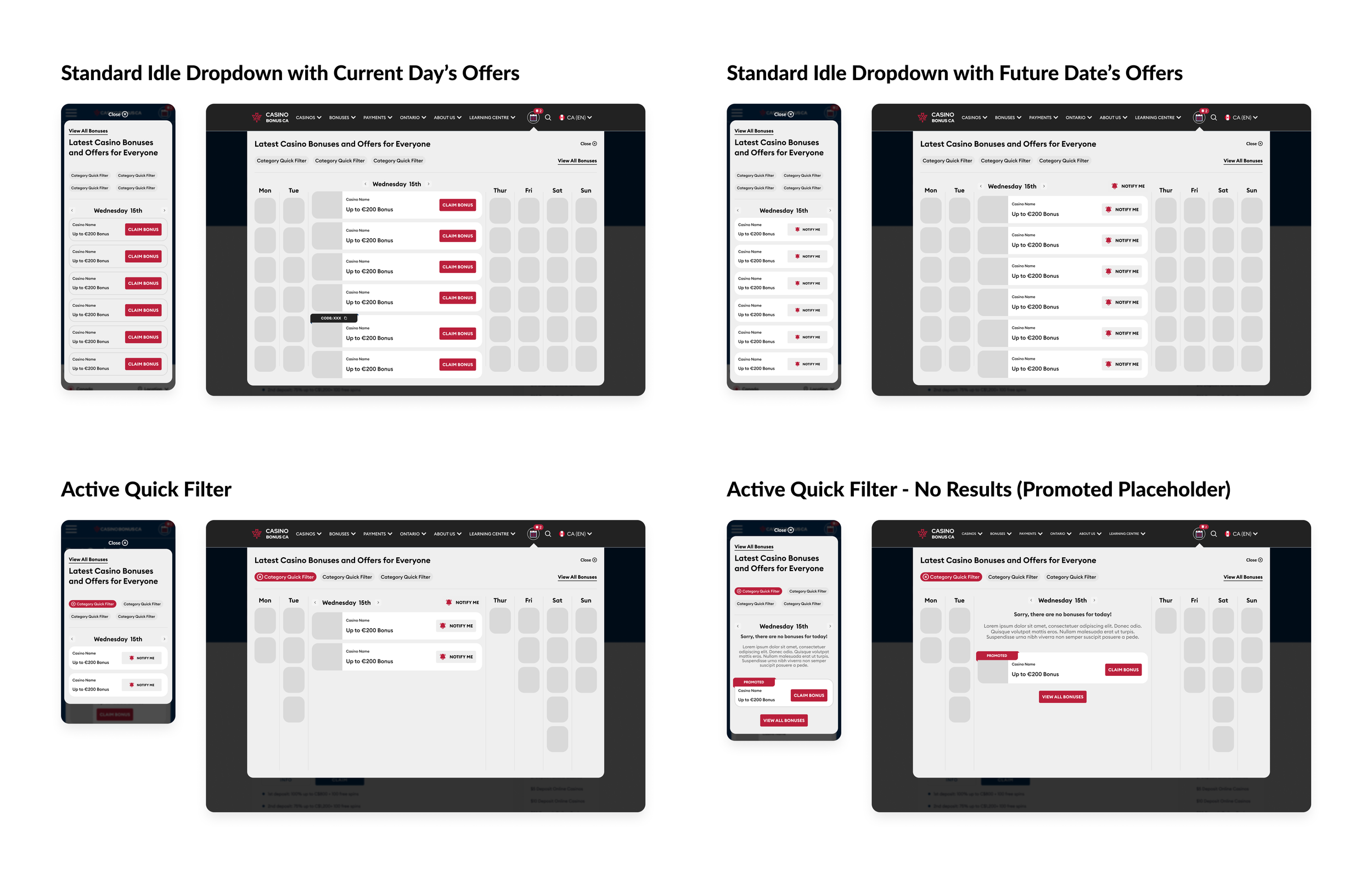
First Stage - High Fidelity
Following the meeting where I presented my findings in my research to stakeholders & the overall team, including engineers, I created a low-fidelity wireframe design and a clickable prototype to bring the ideas and vision to life.
These designs shown display what the user will view when they click the CTA in the navigation to open up the Bonus Calendar feature.
The user is met with the current day’s releases, as well as the option to switch to any other day in the week. As well as this, it was suggested that we include a general CTA to our bonuses pages to ensure that the user’s needs can be met on or off the new feature.
If the user was to navigate to a future day, the CTA presented on the Bonus cards would then switch to a “Notify Me” feature to attract users to sign up and get notified upon release, to ensure repeat visits from users via notifications.
Simple to use, quick filters were positioned at the top of the screen, which will match the content below to the desired properties if applicable. If in the instance that no results are found, I introduced the idea of having a small piece of text explaining the lack of results, accompanied by a sellable position with a promoted partner’s bonus to meet the goal of having a static revenue stream coming in outside of the standard bonus conversion.
The wireframes were agreed upon and ultimately were known to meet the goals desired from the project, as well as the sign-off from the engineering team to be in scope for the desired timeline for launch.
High-Fidelity Wireframes
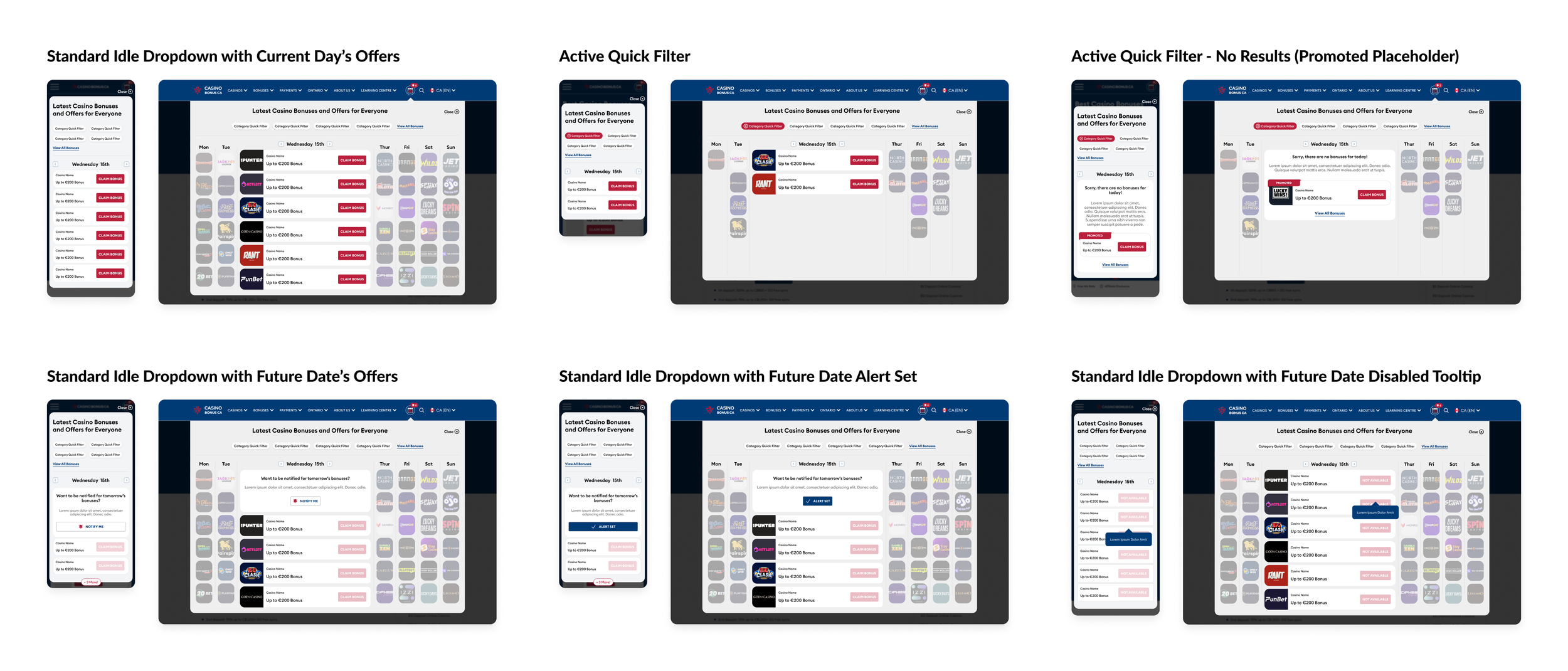
Following the Low-Fidelity wireframes sign-off, we carried out some user & gorilla testing to ensure that the designs were easy to use and effective towards the goals of the project. The High-Fidelity designs were then created, allowing the brand’s personality to be shown on the new feature.
The brand’s personality really comes through with the colour scheme added onto the designs, as well as the partner logos on the cards, with the clear red CTA for conversion.
As you can see in the designs below, we decided to slightly alter the positioning of the filters so that it was clear that it related to all of the days in the centre location. Also, after conversing with the CRM team, we decided that one general alert for the user to be notified with was better than having individual releases as it could end up with a user getting communication for numerous releases on one day, ultimately cluttering and annoying their inbox. The new alert would send a communication on the set day that they set the alert for and showcase all releases from that day. Following the new alert functionality, I introduced a simple-to-activate tooltip to explain to the user why the button was deactivated to avoid confusion.
The designs were then presented to all of the team on the project, to then get final sign-off and set for another round of testing before engineering handover.
Engineering Handover
Following the success of the designs, as well as cross-team sign-off on their goals being met, I then curated a detailed handover document for the engineers to start carrying out the next stage of the project.
Once the handover was completed and checked by product & stakeholders, I organised a meeting with the engineering team to go over first looks in the handover, as well as providing them the link 48 hours before to ensure that if they had any concerns, we can discuss in the meeting together. A snapshot of one of the numerous pages in the handover is shown here.
During the engineering process, I organised 2x a week catch-ups with Product Owners, Managers and Stakeholders to go over anything that was causing problems to ensure that we were all on the same page with the production.
Upon completion, we carried out numerous design QA’s to ensure the quality was up to the standard required, as well as extensive feature testing to iron out any bugs & errors.
The Conclusion
The release of the Bonus calendar was a success and attracted a large number of users to the site, as well as signing up for CRM alerts. As well as this, the commercial and product teams were happy that we had a new source of promoted revenue with the new position introduced on the calendar.